Plastic pollution has become a growing global concern, not only for the environment but also for human health. Recent scientific research suggests that microplastics and nanoplastics may have potential links to neurological disorders such as Parkinson’s disease.
As plastic production continues to increase worldwide, scientists are investigating how microscopic plastic particles may accumulate in the human body and potentially affect biological processes.
What Are Microplastics and Nanoplastics?
Microplastics are defined as plastic particles smaller than 5 millimeters, while nanoplastics are even smaller, measuring less than one micrometer.
These particles originate from several sources, including:
- Degradation of larger plastic waste
- Synthetic textile fibers released during washing
- Industrial plastic materials
- Consumer products containing plastic polymers
Due to their extremely small size, microplastics can easily disperse through air, water, and soil, making them widespread environmental contaminants.
How Microplastics Enter the Human Body
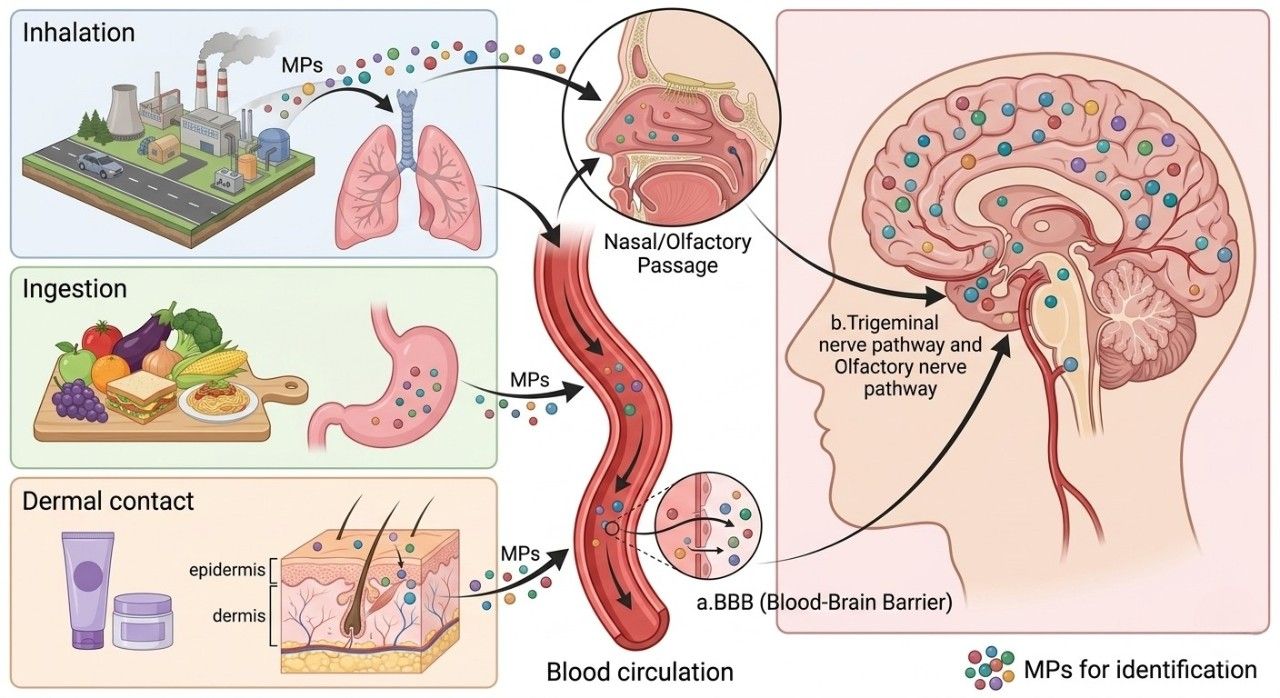
Scientific studies have identified multiple exposure pathways through which microplastics may enter the human body:
1. Ingestion
Microplastics can be consumed through contaminated food and drinking water, including seafood and processed foods.
2. Inhalation
Tiny plastic particles present in the air can be inhaled and enter the respiratory system.
3. Skin Contact
Certain particles may also enter the body through dermal exposure, particularly in environments with high plastic particle concentrations.
Once inside the body, some particles may circulate through the bloodstream and accumulate in various organs.
Can Microplastics Reach the Brain?
One of the most concerning findings from recent studies is the possibility that microplastics may cross biological barriers, including the blood-brain barrier, which normally protects the brain from harmful substances.
Another potential pathway is through the olfactory nerves in the nasal cavity, allowing inhaled particles to travel directly to brain tissues.
This raises important questions about the potential impact of environmental microplastic exposure on neurological health.
Potential Links Between Microplastics and Parkinson’s Disease
A recent scientific review analyzing more than 100 previous studies suggests that microplastics may influence biological mechanisms associated with Parkinson’s disease.
One key focus is the protein alpha-synuclein, which forms abnormal aggregates in the brains of individuals with Parkinson’s disease. Some experimental studies indicate that microplastics and nanoplastics may promote the formation of these toxic protein clumps.
Researchers have also identified several potential mechanisms through which microplastics may affect the nervous system:
- Neuroinflammation in brain tissues
- Disruption of the gut-brain axis
- Transport of heavy metals into neural tissue
- Ferroptosis, a form of iron-dependent cellular damage
These processes have previously been associated with the development of neurodegenerative diseases.
Current Research Limitations
Despite growing scientific interest, researchers emphasize that the relationship between microplastics and Parkinson’s disease is still under investigation.
Many existing studies are based on:
- Laboratory experiments
- Cell culture studies
- Animal models
- Computational simulations
Therefore, more long-term human studies are required to confirm how microplastics affect neurological health.
Microplastics as an Emerging Environmental Health Issue
Beyond neurological concerns, increasing research links microplastic exposure to other potential health risks, including:
- Reproductive and fertility problems
- Cardiovascular disease
- Inflammatory responses
- Antimicrobial resistance
These findings highlight the importance of environmental monitoring and advanced laboratory analysis to better understand the impact of microplastic contamination.
The Importance of Research and Environmental Monitoring
Scientists worldwide are calling for stronger efforts to:
- Reduce global plastic pollution
- Improve waste management systems
- Develop biodegradable alternatives to conventional plastics
- Expand research on microplastic toxicity
Future studies are expected to investigate how different properties of microplastics—including particle size, shape, surface charge, polymer type, and degradation state—influence their biological effects.
As environmental contamination continues to increase, understanding the health implications of microplastics will be essential for protecting both ecosystems and human health.
Source Reference :
Adapted from research published in npj Parkinson’s Disease and reported by ScienceAlert.